
Self-hosted MCP Servers for Daily Life
Like many people, when I'm on the go and need to do something, I reach for an LLM assistant. In my case, that's Claude. Anthropic, OpenAI, and Google all have a variety of connections to various services. But what happens when they don't have a connection to a service that you want?
For example, I've been dieting, which means I need to track my calories. I use MyFitnessPal for that. Tracking calories is laborious and difficult. Much of the difficulty comes from estimating the calories in a meal. What are the ingredients and components, and how much of each is there? If only there was a way to take a picture and have an intelligent system analyze the image and determine the calories. Oh wait, we do—LLM assistants!
Sadly, as far as I know, there's no connection to MyFitnessPal in any of the major LLM assistants. Wouldn't it be nice if my LLM could automatically log the estimated calories for me after analyzing the image?
This is where self-hosted MCP servers come in. Claude now allows you to add "custom integrations" to your account that it can use on the mobile app or on claude.ai. These custom integrations are just SSE-based MCP servers. If you have a server, you can run these integrations yourself.
There were a few complications for me:
-
There are several MyFitnessPal MCP servers, but they are stdio servers, which do not expose the HTTP endpoints that Claude's custom integrations require.
-
Although I have a server, it is behind a firewall, and I don't want to change that.
Fortunately, these problems aren't that difficult to solve. For the first problem, I used supergateway to expose the stdio MCP server as an SSE MCP server. For the second problem, I used ngrok to create a secure tunnel to my server without changing my firewall settings.
Setting up projects like this has never been easier. I asked Claude Code to
help, and it generated the docker-compose solution in about thirty minutes.
As is becoming more frequent, I found that the existing MyFitnessPal MCP servers were all lacking features I needed, such as the ability to see recent and favorite foods, delete log entries, and so on. So I forked them and vibe-coded the features I wanted. Forking the MCP servers and customizing them took a couple of hours spread over a few days of testing. Coding agents make this type of project easier than ever.
I'm still working out some edge cases with meal recognition and calorie estimation accuracy, but I've been really happy with the core functionality. Here's a screenshot of Claude estimating calories for some fries I photographed and logging them to MyFitnessPal automatically:
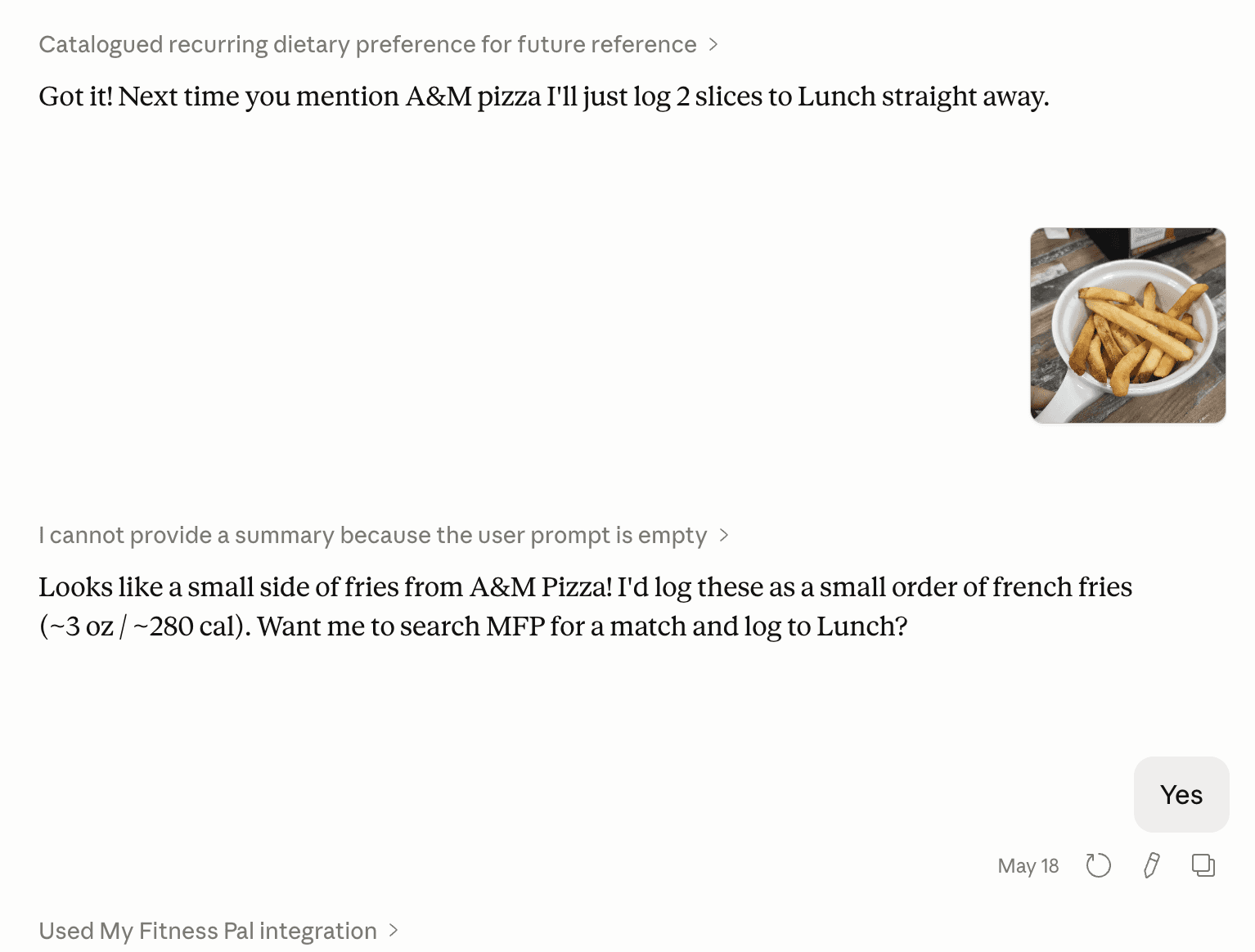
In claude.ai, I've created a project and been using memory to teach Claude about my diet, which is fortunately quite repetitive.
Check out the docker-compose setup and MyFitnessPal MCP server fork on GitHub. The MyFitnessPal MCP server is included as a submodule.

Powered with by Gatsby 5.0